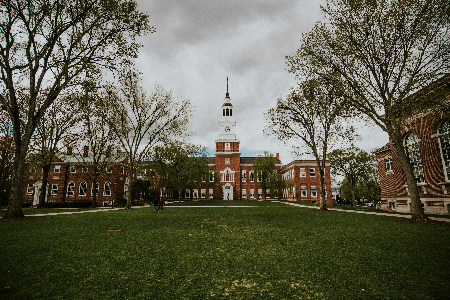
A majority of Yale University faculty members say their academic freedom has decreased in recent years, and half fear losing their jobs for teaching about controversial topics, according to a survey released today.
Of the 177 faculty members surveyed by the Yale chapter of the American Association of University Professors, 68.4 percent said their academic freedom has “decreased somewhat” or “decreased a great deal” since January 2025. About a third reported that their academic freedom has remained the same, and one respondent said their academic freedom has increased.
The protests that greeted Department of Homeland Security General Counsel James Percival a UCLA School of Law in April were not surprising. Law students, especially at highly ranked schools like UCLA, have become notoriously intolerant of disfavored speakers coming to campus — and few institutions are quite as polarizing as DHS in the “Abolish ICE” era. It was striking, however, that the students who organized the interruptions of Percival’s presentation — with heckling, hacking coughs, cellphones, and the occasional profanity — did exactly what “snowflake” students have been ridiculed and denounced for doing when encountering someone they don’t agree with.
What happens when an entire profession can’t see what’s hiding in plain sight in its own data? That puzzle animated Stony Brook University sociologist Musa al-Gharbi’s keynote at the Heterodox Academy 2026 West Coast Regional Conference, held recently at UC Berkeley.
The deeper problem, he contends, is not bad-faith activism but a structural one: peer review, editing, and committee deliberation only correct for bias when the people doing the correcting actually differ from one another, and the academy and the press increasingly do not. His full speech is transcribed below.
Two years after protests over the Israel-Hamas war roiled college campuses, resulting in the arrests of more than 3,000 students and faculty, a new study finds that students generally oppose punishing “objectionable speech,” unless they consider it “highly harmful.”
The study, conducted by researchers from the Universities of Pennsylvania and Colorado and Stanford and Columbia Universities and published in April in Science Advances, also found that students’ views of objectionable speech depend largely on whom it is targeted at.
America’s colleges have had a rough go of it in recent years. After the Great Recession sent students flooding back to campus, schools have faced one evolving crisis after another: COVID, government interference, protests, and the chaos of AI tools in the classroom. Despite some positive enrollment trends, schools are also staring down a very near future where there will simply be fewer 18-year-olds to fill their seats.
Is the purpose of college just to get a good job, or is there more to it? And though the nation’s colleges and universities have been in rough spots before, is it finally time to start rethinking their entire model? On this week’s Radio Atlantic, the Atlantic contributing writer Ian Bogost and I sift through the fraught landscape of American higher education.
Harvard faculty voted to impose a roughly 20 percent cap on A grades beginning in fall 2027, approving the College’s most aggressive attempt in decades to reverse grade inflation and reshape academic standards.
Faculty voted 458 to 201 for the first plank of the three-part proposal, which will limit A grades in undergraduate courses to 20 percent of enrollment, with flexibility for up to four additional A’s. Faculty also approved a companion measure to use average percentile rankings, rather than GPA, to determine internal awards and honors. That measure passed 498 to 157, with 76 percent of participating faculty in favor.